Smart Ring Blood Pressure Monitoring: What “Blood Pressure Signals” Actually Measures — and What It Doesn’t
This post contains affiliate links. If you buy through a link, I may earn a commission at no extra cost to you.
Medical Disclaimer: This article is for general information only and is not medical advice. Smart rings are not FDA-cleared to diagnose, treat, or monitor hypertension or any other medical condition. Readers should consult a qualified healthcare provider for any questions about blood pressure or cardiovascular health.
Oura called it “blood pressure signals” in their Ring 5 launch. Not “blood pressure monitoring.” That distinction is everything — and most of the coverage from launch week glossed right over it.
Here’s the truth: no smart ring on the market today can measure your blood pressure the way a cuff can. What they can do is detect patterns in your pulse waveform that correlate with blood pressure changes over time. It’s useful. It’s also something very different from the number your doctor reads off the device on your arm. This post explains the difference, what each ring actually claims, and when any of this matters for you.
How blood pressure measurement actually works
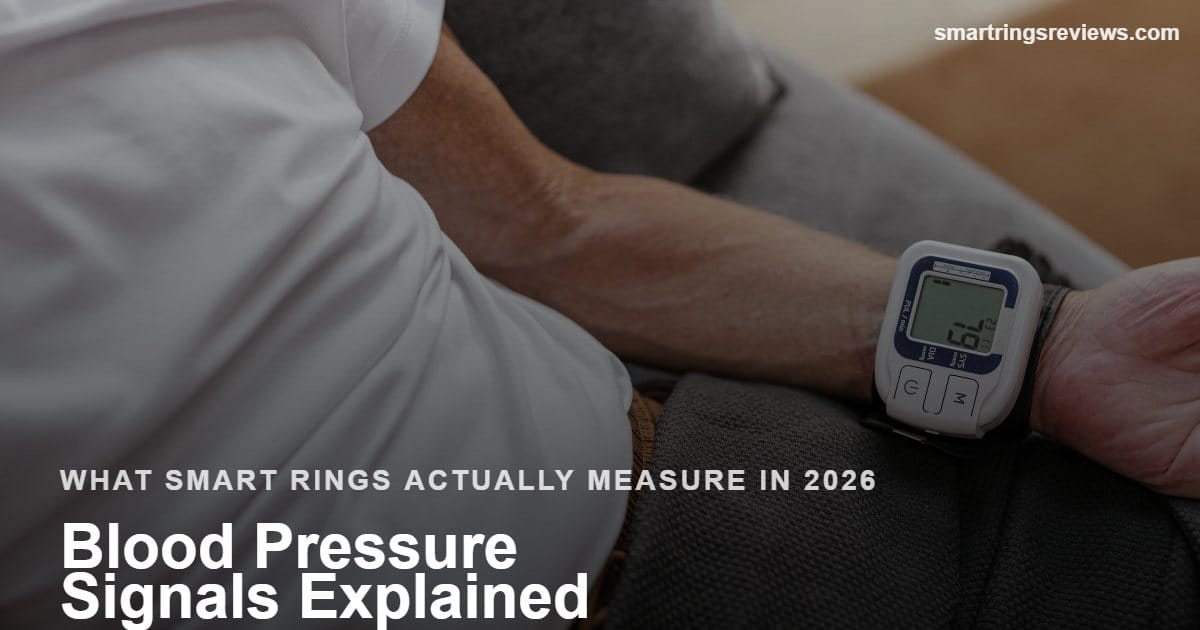
A blood pressure cuff (sphygmomanometer) works by temporarily cutting off circulation in your arm and then slowly releasing pressure while listening for the pulse to return. The numbers — systolic over diastolic — measure actual mechanical pressure in your arteries in millimeters of mercury.
Smart rings use a different technology entirely: optical sensors called photoplethysmography, or PPG. PPG works by shining light through your skin and measuring how much is reflected back. Blood absorbs more light than surrounding tissue, so the sensor can detect the timing and shape of each pulse wave as it passes through your finger.
From that pulse waveform, rings can calculate heart rate and blood oxygen with reasonable accuracy. Blood pressure, however, requires additional inference — the waveform shape does carry some pressure-related information, but converting it to an actual mmHg reading is far harder, and no ring has passed the clinical validation needed to make that claim.
What “blood pressure signals” actually means
When Oura says “blood pressure signals” in the Ring 5, they’re being careful with language for a reason. The feature detects changes in your pulse wave pattern that may correlate with changes in blood pressure — not your actual blood pressure reading. Think of it as a trend indicator: if your waveform pattern shifts in a direction associated with elevated BP, the app surfaces that as a signal worth paying attention to.
This is legitimately useful. A sudden, sustained shift in your signals — especially combined with other Ring 5 data like elevated resting heart rate and poor sleep quality — could be an early prompt to check your actual BP with a cuff. It’s a flag, not a reading.
What it isn’t: a replacement for a blood pressure cuff, a diagnostic tool, or anything a cardiologist would use to adjust your treatment. Oura’s own product page is careful about this framing; so is every legitimate health publication that covered the launch.
Which smart rings make blood pressure claims — and what they actually mean
Oura Ring 5
The most credible claim in the category. Oura’s “blood pressure signals” feature uses multi-wavelength PPG combined with the Ring 5’s improved sensor array. The feature is labeled explicitly as a trend indicator, not a BP reading. Oura requires an active Oura Membership ($5.99/month or $69.99/year) to access BP signal data in the app.
BKWAT Smart Ring
BKWAT lists “blood pressure” as a sensor feature across its VDR, VFR, and RMP SKUs. At $45–$88, these are budget-tier rings on OEM hardware. The “BP” measurement these provide is typically a wrist-derived estimate based on pulse wave velocity — a rough ballpark, not a clinical reading. Don’t rely on it for any health decisions. It’s fine as a general lifestyle tracker at that price point, but the BP data should be treated as directional at best.
Buy BKWAT on Amazon → | Buy BKWAT: Official Site →
Samsung Galaxy Ring
Samsung’s Galaxy Ring does not currently claim blood pressure monitoring — that feature lives in the Galaxy Watch with its dedicated BP sensor. The Ring focuses on sleep, activity, and heart rate. Worth clarifying because Samsung’s broader Galaxy ecosystem does include BP monitoring, just not via the ring.
RingConn Gen 3
RingConn Gen 3‘s primary new health features are vascular health insights and vibration alerts — not a blood pressure reading per se. The “vascular health” framing is similarly trend-based rather than measurement-based.
The gap between “signals” and measurement
A few numbers to frame this: the Association for the Advancement of Medical Instrumentation (AAMI) requires blood pressure devices to be accurate within ±5 mmHg of a reference standard. Validated cuffs hit that bar. Smart ring BP estimates, as of mid-2026, have not publicly cleared that bar through peer-reviewed validation studies.
That doesn’t make the signal data worthless — it means you should use it for what it is: a biometric trend signal that might prompt you to pull out your cuff, not a number to compare against your doctor’s readings.
What this is actually good for
Used correctly, blood pressure-adjacent signals from a smart ring are most useful as a lifestyle correlation tool. If you introduce regular exercise and your BP signals trend down, that’s a useful data point even without knowing your exact mmHg. If you go through a high-stress work period and your signals spike, that’s a prompt to check in with your cuff.
The rings are genuinely good at continuous, passive monitoring — something a cuff can’t do by design. That “always-on” quality is what makes the trend data interesting, even when the individual readings are imprecise.
The bottom line
If blood pressure monitoring is a primary reason you’re looking at smart rings, the Oura Ring 5‘s “blood pressure signals” feature is the most responsibly framed option in the category — but understand that it’s a trend indicator, not a measurement. For anyone with hypertension, on blood pressure medication, or with a cardiovascular condition, it is not a substitute for a validated cuff. Your doctor agrees.
If you want BP-adjacent data as one signal among many in a broad health picture, the Ring 5’s signals combined with its sleep, HRV, and readiness data can be a genuinely useful input. Just keep the cuff handy.
Frequently Asked Questions
Can smart rings measure blood pressure accurately?
No smart ring currently on the market provides clinically validated blood pressure measurements equivalent to a cuff. Rings like the Oura Ring 5 provide “blood pressure signals” — trend indicators based on pulse waveform analysis — which can flag changes but cannot replace a cuff reading for medical purposes.
What is “blood pressure signals” on the Oura Ring 5?
Oura’s “blood pressure signals” uses multi-wavelength PPG sensors to detect changes in your pulse waveform that may correlate with blood pressure fluctuations. It shows trends over time and flags notable shifts, but does not display a systolic/diastolic reading. Access requires an active Oura Membership subscription.
Is any smart ring FDA-cleared for blood pressure monitoring?
As of mid-2026, no smart ring has received FDA clearance for blood pressure measurement. Some rings are FDA-registered (meaning the manufacturer has filed a registration), but registration and clearance are different — FDA clearance requires demonstrated clinical accuracy. Always check current FDA device listings for the most up-to-date status.
Can I use a smart ring to manage my hypertension?
No. Smart ring blood pressure signals are not validated for hypertension management and should not replace medication, a validated cuff, or your healthcare provider’s guidance. If you have hypertension, use an AAMI-validated cuff and follow your doctor’s recommendations. The ring data can be a supplemental lifestyle-tracking tool, not a clinical management tool.
Which smart ring has the best blood pressure monitoring?
Among current rings, the Oura Ring 5 has the most transparently framed blood pressure signal feature, backed by Oura’s multi-wavelength sensor hardware. Budget rings like BKWAT include a BP estimate function but use lower-grade hardware and should be treated as rough directional data only. No ring in the category matches a validated cuff for accuracy.