Smart Rings and Menopause: What Oura’s New Menopause Insights Feature Tracks (and What It Misses)
This post contains affiliate links. If you buy through a link, I may earn a commission at no extra cost to you.
Medical Disclaimer: This article is for general information only and is not medical advice. Smart rings and wearable devices are not medical devices for diagnosing, treating, or managing menopause or any other health condition. Readers should consult a qualified healthcare provider for guidance on menopause symptoms and treatment options.
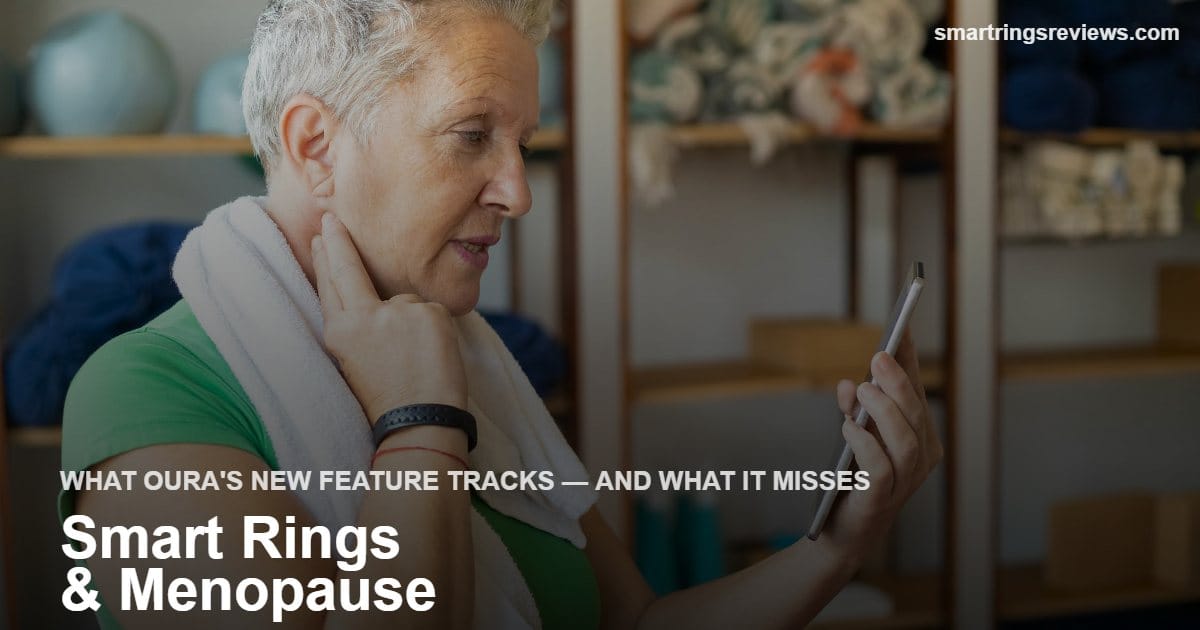
Menopause is one of the most data-rich — and data-scarce — periods of a woman’s life. Symptoms vary wildly: disrupted sleep, elevated heart rate, temperature swings, mood shifts. Most wearables weren’t built with any of this in mind. Oura’s Menopause Insights feature, introduced with the Ring 5, is a genuine attempt to change that. Here’s what it actually does.
Why menopause is hard to track — and why rings might help
The core menopause symptoms that are trackable with biometric sensors are the ones that show up in data:
- Sleep disruption. Night sweats and hot flashes interrupt sleep architecture — specifically deep sleep and REM. This shows up clearly in sleep stage data and HRV readings.
- Temperature fluctuation. Body temperature shifts are a hallmark of hot flashes. Smart rings with skin temperature sensors can detect nighttime temperature spikes that correlate with vasomotor symptoms.
- Resting heart rate changes. Hormonal shifts during menopause can cause resting HR elevation and increased heart rate variability over time. Rings tracking long-term HR trends can surface these patterns.
- Recovery and readiness impact. Sleep disruption and hormonal fluctuation compound into lower readiness and higher daytime stress scores — which a ring tracks continuously.
The caveat: tracking these signals doesn’t mean treating them. A ring showing sleep disruption or temperature spikes is a data source, not a clinical tool. But having longitudinal data to bring to your doctor — “here’s what my sleep looked like for the past three months” — has real informational value.
What Oura’s Menopause Insights feature actually tracks
Oura Menopause Insights, available on Ring 5 with an active Oura Membership, focuses on:
- Skin temperature trends. The Ring 5’s improved sensor array tracks nightly skin temperature deviation from baseline. Significant nighttime temperature spikes — consistent with hot flash events — are surfaced in the app with a timeline view.
- Sleep disruption correlation. The feature connects temperature spike events with sleep stage disruption, showing whether hot flashes are associated with waking or light-sleep periods.
- HRV and readiness impact. Menopause Insights contextualizes readiness score dips and HRV changes within a menopause-aware framework — rather than just flagging “low readiness” without context, the feature notes when patterns are consistent with vasomotor symptoms.
- Longitudinal trend view. A dedicated dashboard shows how symptoms have tracked over weeks and months — useful data for conversations with a healthcare provider.
What it misses
Being honest about the gaps is important here:
- It doesn’t measure hormones. Estrogen, progesterone, FSH — the biological drivers of menopause — aren’t detectable by an optical ring sensor. The feature works from physiological signals (temperature, HR, sleep), not hormonal data.
- It can’t distinguish menopause from other causes. A night of bad sleep with a fever looks a lot like menopause symptoms in the data. The ring doesn’t know why your temperature spiked — only that it did.
- No clinician validation. Oura’s Menopause Insights is a consumer wellness feature, not a clinically validated diagnostic tool. The patterns it surfaces haven’t been peer-reviewed as diagnostic criteria. Use it as a personal data tool, not a clinical reference.
- Ring 5-only. If you’re running a Ring 4 or Gen 3, Menopause Insights isn’t available. The Ring 5’s upgraded temperature sensing is required.
- Membership required. The feature is behind the $5.99/month Oura Membership paywall — the base ring price doesn’t include it.
Oura Ring 5 vs. Evie Ring for women’s health tracking
Oura isn’t the only ring with a women’s health focus. Evie Ring (by Movano Health) was built specifically for women — it’s FDA-registered as a Class II medical device for pulse oximetry and markets explicitly around menstrual cycle, mood, and energy tracking.
| Oura Ring 5 | Evie Ring | |
|---|---|---|
| Menopause-specific feature | Yes (Menopause Insights) | No specific menopause feature |
| Temperature tracking | Yes | Yes |
| Cycle tracking | Yes (Cycle Insights) | Yes (primary focus) |
| Subscription | $5.99/month | No |
| FDA status | FDA-registered (some features) | FDA-registered (Class II) |
| Price | $399–$499 | ~$269 |
| Design | Unisex | Women-specific sizing/design |
If menopause tracking is your primary reason for buying a smart ring, Oura Ring 5 is currently the most feature-complete option. Evie is worth considering if subscription-free women’s health tracking is the priority and menopause-specific analytics are less important than cycle and mood data.
Check Price — Oura Ring 5 on Amazon →
Choose Oura Ring 5 if / Choose Evie if
| Choose Oura Ring 5 if… | Choose Evie Ring if… |
|---|---|
| Menopause Insights and temperature trending are core to your purchase | You want subscription-free women’s health tracking |
| You want the most complete sleep + recovery platform | Cycle and mood tracking are your primary priorities |
| You’re on HRT and want longitudinal tracking to share with your provider | Budget is a factor (Evie is significantly less expensive) |
| You’re already invested in the Oura ecosystem | You want a ring built specifically around women’s sizing |
The bottom line
Oura’s Menopause Insights is the most thoughtfully designed attempt in the smart ring space to address a health phase that wearables have historically ignored. It won’t replace your gynecologist or measure your hormones — but as a tool for spotting patterns, tracking symptom trends, and having more informed conversations with your healthcare provider, it’s meaningfully useful.
If you’re in perimenopause or menopause and already considering a smart ring, the Ring 5 is the one to look at. Just go in with realistic expectations about what a consumer wearable can and can’t do.
Frequently Asked Questions
Can a smart ring detect menopause?
No smart ring can detect or diagnose menopause — that requires hormonal testing (FSH, estrogen levels) done by a healthcare provider. What rings like the Oura Ring 5 can do is track physiological signals associated with menopause symptoms, such as nighttime temperature spikes, sleep disruption, and heart rate variability changes, and surface them as trends over time.
What is Oura’s Menopause Insights feature?
Oura Menopause Insights is a Ring 5-exclusive feature (requires Oura Membership) that tracks skin temperature deviations, sleep disruption patterns, and HRV changes within a menopause-aware framework. It provides a longitudinal dashboard to help identify symptom patterns — useful context for conversations with a healthcare provider, but not a clinical diagnostic tool.
Does the Oura Ring track hot flashes?
The Oura Ring 5 tracks nighttime skin temperature deviations that may correspond with hot flash events. It doesn’t identify hot flashes as a named event, but significant temperature spikes that correlate with sleep disruption are surfaced in the Menopause Insights dashboard. It’s a proxy signal, not a direct measurement.
Is the Oura Ring safe to wear during menopause?
Yes — wearing a smart ring during menopause carries no specific safety concerns. The ring uses optical sensors (light-based) and accelerometers; there are no contraindications for use during menopause. As with any health tracking device, the data it produces should be discussed with your healthcare provider rather than used to make independent medical decisions.
Which smart ring is best for women’s health tracking?
For women in perimenopause or menopause, the Oura Ring 5 is currently the most feature-complete option, with dedicated Menopause Insights and Cycle Insights features. Evie Ring (by Movano Health) is a subscription-free alternative built specifically for women, with a focus on cycle and mood tracking — though it lacks a dedicated menopause analytics feature as of mid-2026.