Smart Ring vs. Smartwatch vs. Patch: Which Wearable Wins in 2026?
This post contains affiliate links. If you buy through a link, I may earn a commission at no extra cost to you.
This article is for general information only and is not medical advice. Readers should consult a qualified healthcare provider for diagnosis or treatment.
The wearable category in 2026 isn’t one shape anymore. The same person who’d have asked me “Apple Watch or Garmin?” three years ago is now asking “ring or watch or patch?” — and the honest answer depends on what you actually want the data for. These three form factors aren’t direct competitors. They’re solving overlapping problems in very different ways.
Here’s how smart rings, smartwatches, and biometric patches stack up — and how to figure out which one (or which combination) fits your life.
Side-by-side: smart ring vs. smartwatch vs. patch
| Attribute | Smart Ring | Smartwatch | Health Patch (CGM) |
|---|---|---|---|
| Typical wear time | 5–8 days per charge | 1–7 days per charge | 10–15 days per sensor |
| Form factor | Worn on finger; invisible to most observers | Worn on wrist; highly visible | Adhesive on upper arm; mostly hidden under sleeves |
| Screen | None — phone app only | Built-in touchscreen | None — phone app only |
| Heart rate | Continuous PPG | Continuous PPG (some ECG) | No |
| Sleep tracking | Strong (best body location) | Decent (worse for restless sleepers) | No |
| SpO2 | Yes (most rings) | Yes (most watches) | No |
| Glucose | No (some integrate with CGM apps) | No (some integrate) | Yes — that’s the entire point |
| Notifications | No | Yes | No |
| Workout features | Basic (steps, HR) | Strong (GPS, sport modes, music) | None |
| Typical price | $199–$549 | $199–$799+ | $49–$99 per month (subscription) |
| Subscription | Sometimes (Oura) | Rare | Always |
| Replaces | Nothing on your wrist | Watch + fitness tracker + sometimes phone | Lab glucose tests |
What each one is actually good at
Smart rings: best for sleep, recovery, and being unobtrusive
The finger is the right place on your body to measure resting biometrics overnight, because there’s reliable blood flow and you’re not moving. That’s why rings consistently produce better sleep data than watches do, especially if you’re a restless sleeper or wear your watch loose. They’re also invisible — no glowing screen on your wrist during a meeting, no “are you on your phone?” tension when you check the time.
The trade-off is they don’t do the things a watch does. No notifications, no GPS for runs, no music control, no contactless payment. If you want passive health data and nothing else, that’s a feature. If you want a “wearable computer,” it’s a deal-breaker.
Smartwatches: best for workouts, notifications, and being a small phone
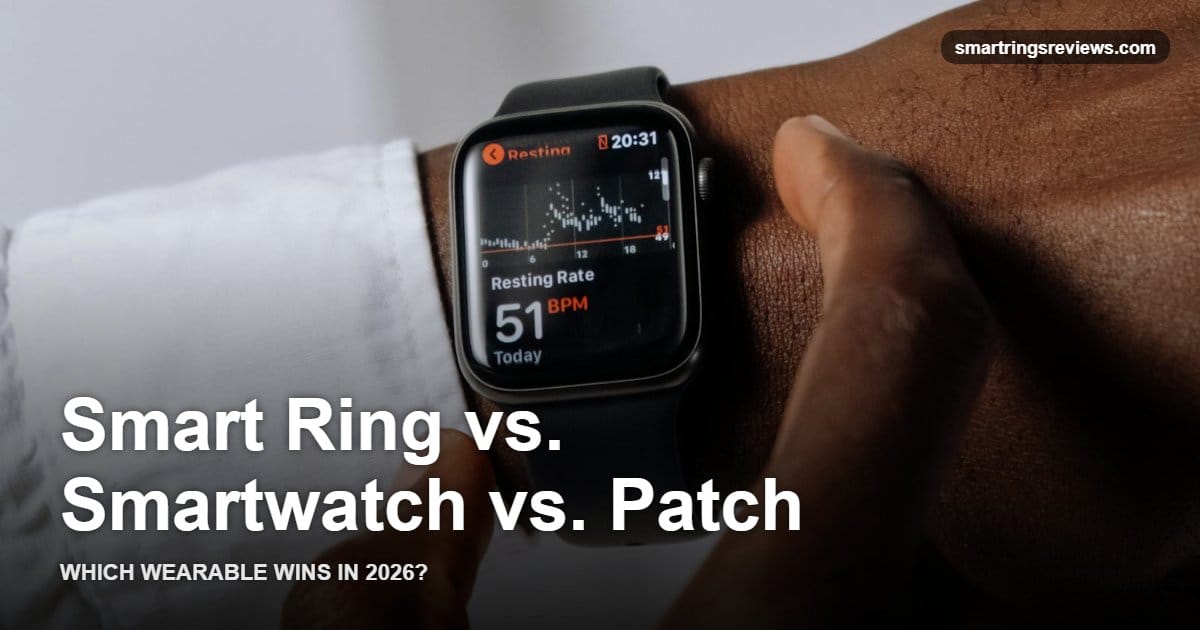
Smartwatches are the Swiss Army knife. GPS-tracked runs, full notification mirroring, contactless pay, music, voice assistants, ECG on the higher-end models, and yes, decent (not great) sleep tracking. Apple Watch and Galaxy Watch are the obvious flagships; Garmin owns the serious-athlete tier.
The trade-off is form factor and battery. A smartwatch on your wrist is visible whether you want it to be or not, and the daily charge cycle on Apple Watch is a real friction point. Sleep tracking is also genuinely worse than what a ring gets — you’ll see the divergence the first time you compare them on the same night.
Health patches (CGMs): best for one specific signal — but it’s a powerful one
The consumer CGM era arrived in 2024 with Stelo (Dexcom) and Lingo (Abbott), both available without a prescription in the US. Patches stuck on the back of your upper arm read interstitial glucose every few minutes for 10–15 days, then come off. The data is uniquely useful: you can actually see what specific foods, workouts, and stresses do to your blood sugar.
The trade-offs are real, though. CGMs are subscription-only — you’re paying $50–$100 a month, indefinitely. They measure exactly one thing. They require physically swapping a sensor every two weeks. And for most non-diabetic people, the question of whether the data actually changes long-term behavior is still genuinely open.
Choose X if…
| Choose this | If you… |
|---|---|
| Smart ring | Care most about sleep, recovery, and HRV. Already wear a watch and don’t want a second one. Want passive data with zero notifications. Hate charging things daily. |
| Smartwatch | Want one device that does workouts, notifications, payments, and basic health. Run, cycle, or hike with GPS regularly. Don’t mind a daily-or-near-daily charge. |
| Health patch (CGM) | Specifically want to understand your glucose response to food, exercise, and stress. Are willing to pay monthly. Are okay with single-purpose data. |
| Ring + watch | Want best-in-class sleep and 24/7 biometrics from the ring, plus notifications and workouts from a smaller, longer-battery watch (e.g., Garmin or Galaxy). |
| Ring + CGM | Are deep into the metabolic-health rabbit hole. The ring handles sleep, recovery, and HR; the patch handles glucose. Some apps (Ultrahuman in particular) integrate both. |
The bottom line
These aren’t three competitors picking a winner. They’re three different tools for three overlapping jobs. If I had to pick one and only one, I’d pick the smart ring — it’s the lowest-friction way to get useful long-term health data without changing how you live. If I had unlimited budget and curiosity, I’d run all three for a month, see what the data actually told me, and then drop the two I wasn’t using.
Most people overestimate how much they’ll engage with a CGM and underestimate how much value they’d get from a ring’s sleep score. That’s the most common mismatch I see.
Three smart rings worth considering for this comparison
Oura Ring 4 — Best sleep and recovery insights, period. The app is the most polished in the category. Subscription is real ($5.99/month), so factor it in. Buy: Official Site | Check Price on Amazon →
Ultrahuman Ring PRO — The ring to pick if you’re also running a CGM. Ultrahuman’s app is built around metabolic-health integration, so it pairs naturally with Stelo or Lingo. No subscription. Buy: Buy Ultrahuman →
RingConn Gen 2 — If you want to add ring data to a smartwatch you already own without a recurring fee, this is the easy answer. Solid sensors, longer battery than most, no subscription. Buy: Official Site | Check Price on Amazon →
Pick the one that fits the gap your current setup leaves — not the one with the most features.
Frequently Asked Questions
Can a smart ring replace a smartwatch?
Only partially. A smart ring beats a watch on sleep and recovery data, and it’s more comfortable for 24/7 wear. But it can’t notify you, can’t track GPS workouts, and can’t make payments. If those things matter, the ring is a complement, not a replacement.
Are CGM patches worth it for non-diabetics?
It depends on what you’ll do with the data. For people experimenting with diet, exercise timing, or stress management, a one-month CGM trial is genuinely educational. For people who want a long-term passive health metric they’ll check casually, a ring is a much better value — CGM subscriptions add up fast.
Can I wear a ring and a smartwatch at the same time?
Yes, and a lot of people do. The most common stack in 2026 is “ring for sleep and recovery, watch for workouts and notifications.” The two devices don’t compete for sensor accuracy — they’re measuring at different times of day in different conditions.
Which is more accurate for heart rate — ring, watch, or patch?
Patches don’t measure heart rate at all. Between rings and watches, rings are typically more accurate for resting HR (they sit on a finger with strong blood flow and you’re often still), and watches are typically more accurate for active HR (they’re tighter against the skin during workouts when finger circulation drops).
What’s the cheapest way to try one of each?
RingConn Gen 2 for the ring, a refurb Apple Watch SE or a Galaxy Watch FE for the watch, and a single 15-day Stelo sensor (~$50) for the patch. You can run all three for under $500 in your first month and decide what’s actually worth keeping.
What to read next
- Best Smart Rings of 2026: The Complete Buyer’s Guide — the current state of the category, ring by ring.
- Oura Ring 4 vs Ultrahuman Ring PRO — the flagship head-to-head most buyers care about.
- Best Smart Rings with No Subscription — the rings that skip the monthly fee entirely.