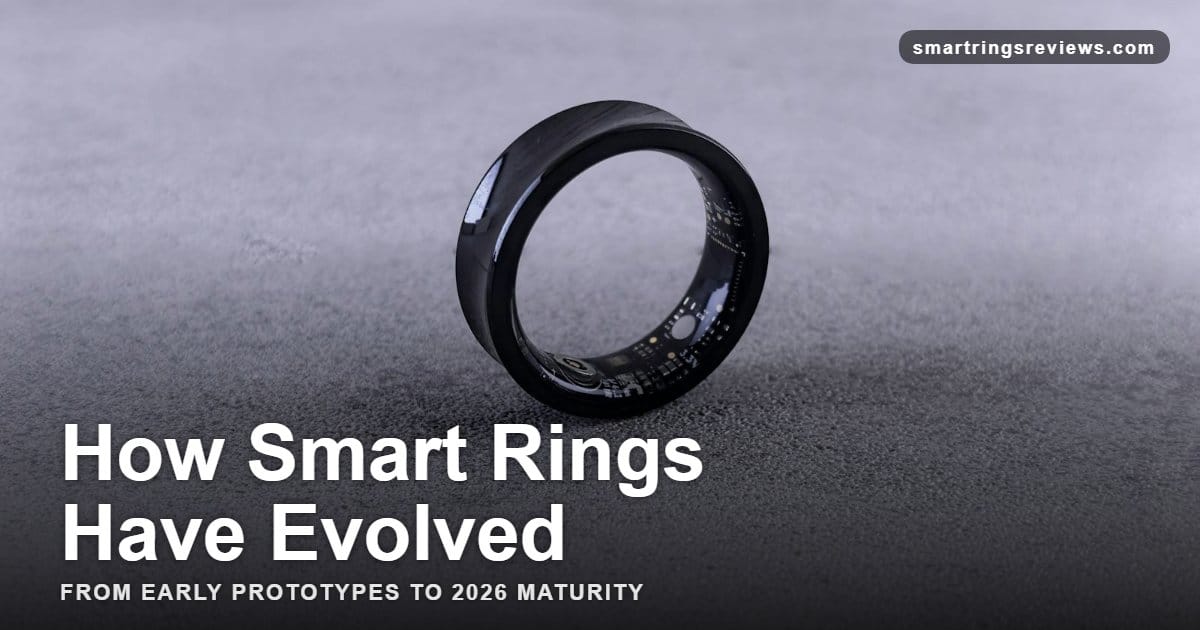
How Smart Rings Have Evolved: From 2014 Prototypes to 2026 Maturity
This post contains affiliate links. If you buy through a link, I may earn a commission at no extra cost to you.
This article is for general information only and is not medical advice. Readers should consult a qualified healthcare provider for diagnosis or treatment.
The first “smart ring” I’d actually call smart launched around 2018. Everything before that was a glorified gesture controller or an NFC payment fob with a press kit. By 2026, the category is crowded enough that the hard question isn’t “should I buy a smart ring” — it’s “which of the seven good ones.”
Here’s how we got here, what changed at each stage, and what the maturing market means if you’re shopping now.
The pre-smart era (2014–2017): gesture rings, NFC fobs, and a lot of vaporware
Smart rings as a Kickstarter category mostly arrived in 2014. The Logbar Ring promised gesture-controlled phone navigation and was, by basically every account, a dud. The McLear Ring (later K Ring) tried NFC payments years before banks were ready in the US. Ringly made fashion rings that buzzed for notifications. Nimb tried personal-safety alerts. None of them stuck because none of them really did anything you couldn’t do better with the phone already in your pocket.
The shared problem: these were peripherals looking for a job. Smart rings didn’t earn their place on your finger until they started measuring something the phone couldn’t.
Oura Gen 1 and Gen 2 (2015–2020): the category gets serious — but stays niche
Oura was the first ring that justified its existence. Gen 1 (2015) and Gen 2 (2018) packed a PPG sensor for nighttime heart rate, an accelerometer for movement, and a skin-temperature sensor — and used that data to score sleep. That was the wedge: a ring is the best place on your body to measure resting biometrics overnight, because you’re not moving and your finger has reliable blood flow.
Gen 2 found its audience among elite athletes, biohackers, and the curious-and-affluent. It was $300, awkward-looking, and required a real commitment. But for the first time, a ring did something a watch couldn’t do as well — and the data was actually trusted by the people wearing it.
The Oura Ring 3 inflection (2021): continuous data, mainstream interest
Oura Ring 3 in late 2021 is the moment the category turned. The big changes were technical — continuous 24/7 heart rate (instead of spot checks), SpO2 monitoring, expanded temperature trends — but the bigger shift was cultural. Pandemic-era interest in sleep, recovery, and “knowing your numbers” pulled rings into the mainstream wellness conversation.
Ring 3 also introduced something that still defines the category: a subscription. Oura Membership at $5.99/month gates most of the actual insights. Without it, your $300 ring becomes a basic step counter. The subscription was — and is — the most argued-about decision in smart rings.
2023–2024: the floodgates open
Once Oura proved the market existed, competitors moved fast.
- Ultrahuman Ring PRO arrived with the “no subscription, ever” pitch as its primary wedge against Oura. One purchase, all features unlocked.
- RingConn entered the budget tier with longer battery life than most competitors and no recurring fee.
- Samsung Galaxy Ring (August 2024) was the first major Big Tech entry — tight Samsung Health integration and the obvious advantage of a billion-dollar marketing engine.
- Evie Ring was the first ring built specifically around women’s health — cycle, mood, and an FDA Class II registration for pulse oximetry.
- Amazfit Helio brought Amazfit‘s watch-pairing playbook into ring form at a budget price.
The pattern across all of them: each picked a wedge — price, no subscription, ecosystem, women’s health — and built around it.
What 2025–2026 actually looks like
The 2026 market has settled into clear lanes:
- Subscription premium: Oura Ring 4. The most mature app, the most refined insights, the deepest research backing. You pay monthly forever.
- No-subscription premium: Ultrahuman Ring PRO. Comparable sensors to Oura, one-time purchase.
- Budget no-sub: RingConn Gen 2 and Amazfit Helio. Solid sleep tracking, longer battery, lower price floor.
- Women’s health: Evie Ring. Built around cycle and mood, FDA-registered pulse oximetry.
- ECG and AFib: Circular Ring 2. The only mainstream ring shipping built-in ECG with AFib detection.
- Ecosystem play: Samsung Galaxy Ring. If you’re already deep in Samsung Health and own a Galaxy phone, the integration is hard to beat.
Underneath those lanes, the basics have converged. Most rings now ship with continuous heart rate, SpO2, skin temperature, accelerometer-based activity, and 5–8 days of battery life. The hardware floor is much higher than it was in 2022. The differences are in app quality, sensor calibration, design choices, and pricing model — not in whether the thing can measure your heart rate.
The bottom line
2026 is a buyer’s market. You don’t have to compromise as much as you did even two years ago. The subscription question is now a real choice — Oura on one side, Ultrahuman or RingConn on the other — instead of a forced cost.
If you’d asked me in 2022 which ring to buy, the honest answer was “probably wait.” If you ask me now, the honest answer is “pick the wedge that matches how you’ll actually use it.”
Three rings worth considering today
Oura Ring 4 — The most mature ring on the market. Best app, best research backing, the gold standard for sleep and recovery insights. The catch is the $5.99/month membership; budget for it before you buy. Buy: Official Site | Check Price on Amazon →
Ultrahuman Ring PRO — The no-subscription answer to Oura. Sensor lineup is comparable, app is good (not Oura-good), and you pay once. If the recurring fee is a dealbreaker for you, this is the obvious pick. Buy: Buy Ultrahuman →
RingConn Gen 2 — The best budget no-subscription ring right now. Longer battery life than most competitors, solid sleep tracking, and a price floor that makes “try a smart ring without committing” actually plausible. Buy: Official Site | Check Price on Amazon →
If you waited until now, you waited well — the floor of what a smart ring can do is much, much higher than it was even two years ago.
Frequently Asked Questions
When did smart rings first come out?
The first wave hit Kickstarter in 2014 — Logbar Ring, McLear, Nimb. Most flopped. Oura’s Gen 1 (2015) was the first ring people actually kept wearing because it was the first one that measured something useful: nighttime biometrics for sleep tracking.
Was Oura really the first smart ring?
Not literally — gesture and NFC rings predate it. But Oura was the first ring that justified being on your finger by doing something a phone or watch couldn’t do better. That’s why it’s treated as the start of the category that exists today.
Why did smart rings take off in 2024?
Three things converged. Oura proved the model worked. Samsung’s Galaxy Ring (August 2024) brought mainstream attention from people who’d never heard of Oura. And Ultrahuman, RingConn, and others showed you could ship a competitive ring without a subscription, which broke the only-Oura mental model a lot of buyers had.
Are smart rings still evolving in 2026?
The basics have converged — continuous HR, SpO2, temperature, 5–8 day battery. What’s still evolving is app quality, additional sensors (ECG and AFib detection are spreading from the Circular Ring 2), and how rings integrate with other health data sources like CGMs and smartphones.
What’s the next big change for smart rings?
Watch for three things: (1) blood pressure estimation moving from “research feature” to shipping feature, (2) tighter integration with continuous glucose monitors for metabolic-health pictures, and (3) the inevitable Apple ring, which would reset the category the same way Galaxy Ring did in 2024.
What to read next
- Best Smart Rings of 2026: The Complete Buyer’s Guide — the current state of the category, ring by ring.
- Oura Ring 4 vs Ultrahuman Ring PRO — the head-to-head most readers care about.
- Best Smart Rings with No Subscription — the modern subscription-free landscape.