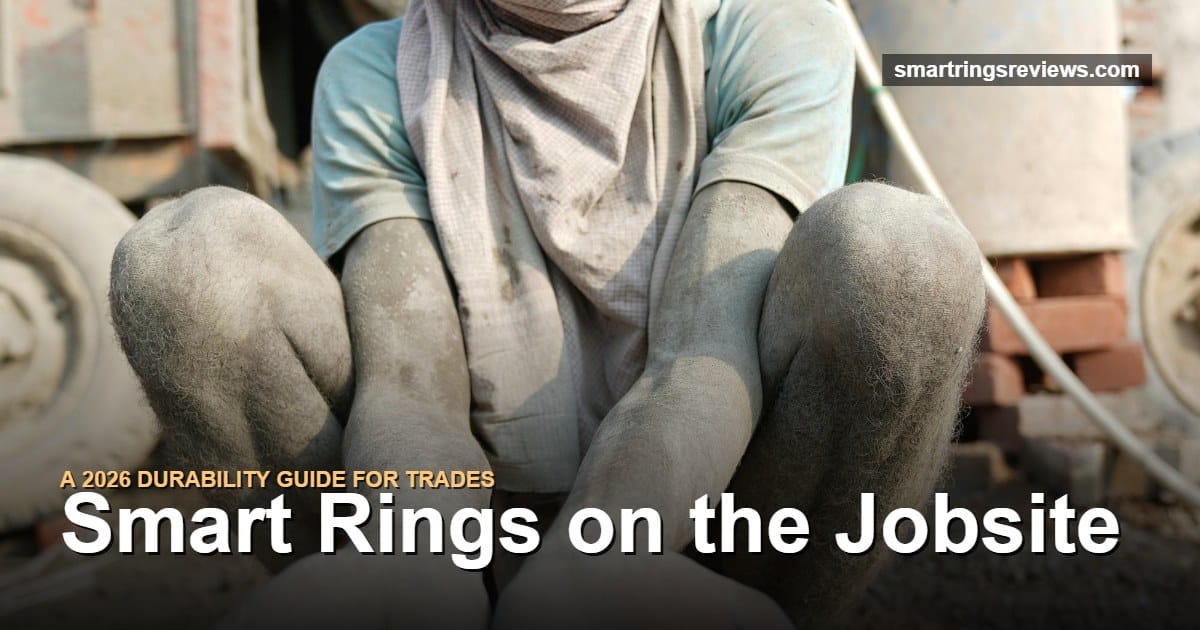
Smart Rings on the Jobsite: Durability for Tradespeople, First Responders, and Heavy-Industry Workers
This post contains affiliate links. If you buy through a link, I may earn a commission at no extra cost to you.
This article is for general information only and is not medical or occupational safety advice. Readers should consult a qualified healthcare provider for any medical concerns and follow their employer’s safety policies and applicable OSHA regulations regarding personal protective equipment and jewelry on the worksite.
Smart rings on the jobsite are an underrated category. The wearable industry markets at desk workers and athletes, but the industries where wearable health tech might actually save someone — construction, fire and EMS, oil and gas, manufacturing — barely show up in the brand pitches. Which is a shame, because the data argument is strongest for workers under heavy physical and thermal stress, and weakest for office workers who already know they slept badly.
The catch: a wrist-worn smartwatch is genuinely hazardous on a jobsite. Smart rings sit closer to the skin, take up less real estate, and don’t have a screen to crack. They are a better form factor for trades. Whether any specific ring can survive the job is a different question, and it is the question this post is about.
I am going to lay out what to actually look for in smart rings on the jobsite, then call out which rings are reasonable picks and which are not.
The “ring on the jobsite” safety issue you have to take seriously first
OSHA and the National Institute for Occupational Safety and Health (NIOSH) have warned for decades about ring avulsion injuries — finger degloving and amputations caused when a ring catches on machinery, falling objects, or scaffolding. This is not theoretical. NIOSH guidance recommends against rings around moving machinery, and many electrical, mechanical, and oilfield employers prohibit metal rings on the job entirely.
Smart rings are mostly titanium with a sealed exterior — strong material, but they don’t break under stress, which is the property that matters here. Traditional silicone “safety rings” are designed to tear away if caught. Smart rings will not.
If you are working with rotating equipment, energized electrical systems, or anything where a ring could catch and not let go: do not wear a smart ring on the job, period. Wear it on shifts where you are not exposed, or wear it on a chain around your neck inside your shirt.
For everyone else — finish carpenters, EMTs, supervisors, trades where ring avulsion is not the primary risk — durability is the next question.
What “durable” actually means for smart rings on the jobsite
The brand spec sheets throw around water resistance numbers and “titanium construction” without much detail. Here is what to actually look at:
Water and dust ingress (IP rating). Look for IP68 minimum. That covers immersion and dust. Most major rings hit IP68. A few claim higher (IP69K — high-pressure jets), which matters if you wash down with industrial sprayers.
Water resistance depth (ATM rating). Different scale. 10 ATM (~100m) is the realistic minimum for hosing, swimming, and sustained sweat. 5 ATM is splash-rated only — fine for an office worker, marginal on a jobsite.
Operating temperature range. Most ring spec sheets bury this. Lithium batteries hate cold. If you work outdoors below 0°F or in industrial heat above 120°F, the published operating range matters more than any sensor spec. Verify this against current first-party documentation before you buy — published ranges shift with firmware revisions.
Impact resistance. Almost no ring publishes a drop or crush spec, because there is not a standard test. Realistically, smart rings tolerate ordinary drops onto concrete fine, but a steel-toe stomp or a dropped tool will end any of them.
Battery life. A 12-hour shift that runs into overtime will smoke a ring with 3-day battery life. Look for 6+ days under typical use. RingConn and Ultrahuman lead the category here.
Charging cadence. Most rings need to be off your finger to charge. A 60–90 minute charge once a week is workable. Daily charging like a smartwatch is not, on a job that runs back-to-back shifts.
Use cases that actually benefit on the jobsite
Three jobsite scenarios where the data is genuinely useful as supplemental information — not as a diagnostic or a replacement for occupational medical screening:
Heat-stress trend awareness. Heart rate, HRV, and skin temperature trending in hot environments (roofers in summer, foundry work, structural firefighters in turnout gear). A ring that flags an unusual cardiac response can be an early signal worth paying attention to. Smart rings are not medical devices for occupational heat-illness diagnosis — they are trend tools.
Sleep recovery for shift workers. Rotating shifts wreck sleep. A ring gives shift workers an actual record of how badly their schedule is hitting them, which can be useful in conversations with employers or providers. Sleep tracking on consumer rings is general wellness information, not a clinical diagnosis.
Cardiac trend awareness for first responders. EMTs, firefighters, and police have elevated cardiac event risk relative to the general population. A ring’s resting heart rate and HRV trend over months can flag changes worth raising with a doctor. This is supplemental information — not a substitute for occupational medical screening or annual physicals.
Smart rings on the jobsite: rings that are reasonable picks for trades
Given the criteria above, here is where I would actually point someone. For a wider view of every option this year, see our complete smart ring buyer’s guide for 2026. If you want to skip the recurring fees that come with Oura, the best smart rings with no subscription roundup is the better starting point.
Ultrahuman Ring PRO
Lighter than most, no subscription, IP68 plus 10 ATM. Best pick if cold weather or hot environments are part of the job, in my view. Verify the published operating temperature range against the current product page before you buy.
RingConn Gen 2
Best battery life in the category, no subscription, IP68. Less premium feel than Oura but the durability-to-price ratio is the strongest in the segment. The one I would recommend most often for trades.
Visit RingConn → | Buy on Amazon→
Oura Ring 4
Best sensor accuracy in independent comparisons. Subscription model is a real drawback for trades workers who don’t want recurring overhead, but the data quality is genuinely better.
I would skip Samsung Galaxy Ring for this specific use case unless you are already deep in the Samsung ecosystem — Samsung phone required for the full feature set, and the durability story is not differentiated. Amazfit Helio is fine for budget-constrained office workers but the build feels margin-thin for trades.
Choose RingConn if / Choose Oura if / Choose Ultrahuman if
- Choose RingConn Gen 2 if you want one ring to live with on the job: cheapest of the three, longest battery, no subscription.
- Choose Oura Ring 4 if data quality matters most and the subscription does not.
- Choose Ultrahuman Ring PRO if extreme temperatures are part of the job and weight on the finger matters.
What to do before you wear one to work
A few things to do, regardless of which ring you pick:
- Check your employer’s policy on rings near energized equipment or rotating machinery. If it is unclear, ask in writing.
- Do not wear the ring during arc welding, MIG/TIG, or any work near high-current electrical sources. Inductive heating of metal on the finger is a real burn hazard.
- Buy two adjacent sizes in your sizing kit and wear each for a full 24 hours, including a shift. Hand swelling on the job is real.
- Keep the charger somewhere accessible at the shop — most ring chargers are tiny and easy to lose in a gang box.
The bottom line on smart rings on the jobsite
Smart rings on the jobsite are genuinely better than smartwatches for most trades — lower snag risk, no screen to crack, less daily fuss. But “smart ring” and “indestructible” are not the same thing, and the safety issues around rings near machinery are real and have to be respected.
If you work in trades and want one ring to live with: RingConn Gen 2 is what I would pick. If you will pay more for the best data quality and don’t mind the subscription: Oura Ring 4. If extreme temperatures are part of the job: Ultrahuman Ring PRO.
Wear it on shifts where you are not exposed to rotating equipment. Wear it on a chain around your neck inside your shirt for the rest. Don’t make this the thing that ends your career.
Frequently asked questions
Are smart rings safe to wear on the jobsite?
It depends on the work. For finish carpenters, EMTs, supervisors, and any role where rotating equipment or energized electrical systems are not the primary risk, a titanium smart ring is a better form factor than a smartwatch. Around moving machinery or energized systems, OSHA and NIOSH guidance recommends against any rings — smart rings included. Wear it off-shift or on a chain inside your shirt in those environments.
Which smart ring is most durable for trades?
RingConn Gen 2 hits the best durability-to-price ratio: IP68, 10+ days battery, no subscription. Ultrahuman Ring PRO is the pick if you work in extreme heat or cold (lighter weight, wider operating temperature range). Oura Ring 4 has the best sensor accuracy but the subscription model is a real drawback for trades workers who do not want recurring overhead.
Can smart rings detect heat illness or heat stress?
No — smart rings are not medical devices for occupational heat-illness diagnosis. They can show trends in heart rate, HRV, and skin temperature that may flag an unusual cardiac response in hot environments, but they are supplemental information for trend awareness, not an alarm or a substitute for occupational medical screening.
What IP rating should a smart ring have for jobsite use?
IP68 is the realistic minimum and covers immersion and dust. A few rings claim IP69K (high-pressure jets), which matters if you wash down with industrial sprayers. Pair the IP rating with at least 10 ATM water resistance for hosing, swimming, and sustained sweat exposure.
Does OSHA prohibit wearing rings on the jobsite?
OSHA and NIOSH recommend against rings around moving machinery or energized electrical systems, primarily because of ring avulsion injuries. Many electrical, mechanical, and oilfield employers prohibit metal rings on the job entirely. Always check your employer policy in writing before wearing any ring — smart or traditional — into a hazardous environment.